
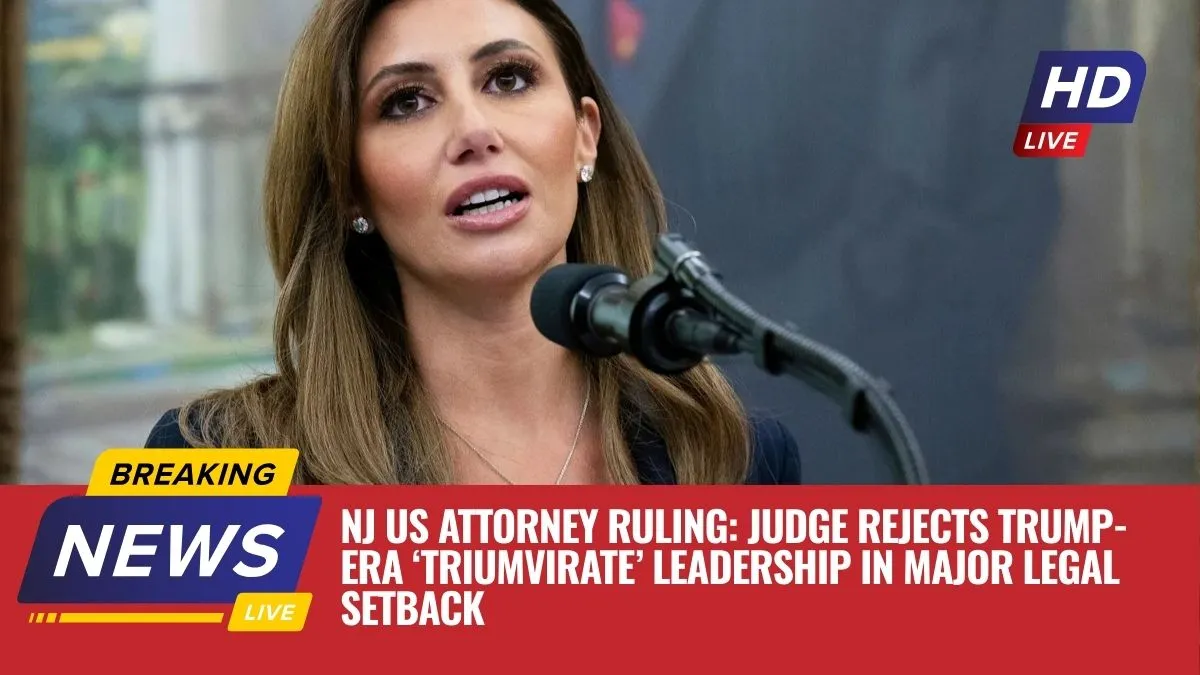
The latest NJ US Attorney Ruling has delivered a major legal setback for the Trump administration’s approach to appointing federal prosecutors. A federal judge in Pennsylvania has ruled that the Justice Department’s decision to install a three-person leadership structure—often described as a “triumvirate”—to run the U.S. Attorney’s Office in New Jersey was unlawful.
In a detailed 130-page opinion, U.S. District Judge Matthew Brann criticized the administration for attempting to bypass traditional legal procedures such as Senate confirmation and judicial appointments. The NJ US Attorney Ruling raises serious questions about the legitimacy of decisions made under the disputed leadership and could affect thousands of ongoing criminal cases.
Federal Judge Declares Leadership Structure Unlawful

The NJ US Attorney Ruling centers on the Justice Department’s decision to install three officials—Philip Lamparello, Jordan Fox, and Ari Fontecchio—to jointly oversee the New Jersey federal prosecutor’s office.
Judge Brann concluded that Attorney General Pam Bondi had no legal authority to appoint this unusual leadership structure simply to satisfy the wishes of President Donald Trump.
In his ruling, Brann questioned why the fate of many federal prosecutions should depend on what he called a “complex and unprecedented leadership arrangement.”

He wrote that the President cannot appoint anyone he wants without following the legal framework established by Congress and the Constitution.
Administration Accused of Bypassing Legal Processes
According to the NJ US Attorney Ruling, the administration attempted to circumvent established procedures designed to ensure oversight of federal prosecutors.
Traditionally, a U.S. Attorney must either:
- Be nominated by the President and confirmed by the Senate, or
- Be temporarily appointed by federal judges when a vacancy occurs.

Judge Brann argued that the administration tried to bend historical legal precedents to maintain control over the office.
He stated that the administration’s actions suggested a desire to avoid the limits placed on executive authority by law.
“One year into this administration, it is clear that the President and his senior advisers have struggled with the legal boundaries placed on their power,” Brann wrote.
Previous Attempt to Keep Trump Ally in Office
The NJ US Attorney Ruling follows an earlier dispute involving Alina Habba, a former personal attorney to Donald Trump.
Habba had been serving as interim U.S. Attorney for New Jersey, but the court previously determined that the administration’s attempt to keep her in the role after her interim term expired was illegal.
After her departure, the Justice Department created the three-person leadership team, which ultimately led to the current legal challenge.
Habba later criticized the ruling on social media, calling it “another ridiculous decision” by Judge Brann.
Judge Warns of Consequences for Criminal Cases
One of the most serious aspects of the NJ US Attorney Ruling is the potential impact on ongoing prosecutions.
The U.S. Attorney’s Office for New Jersey handles some of the most important federal criminal and civil cases in the country. If leadership appointments are deemed unlawful, defendants could challenge the legitimacy of decisions made during that period.
Judge Brann warned that the situation could lead to:
- Dismissed indictments
- Overturned convictions
- Legal challenges affecting numerous cases
However, he also left open the possibility that senior Justice Department officials could retroactively validate certain actions taken by the office.
Dispute Over Who Has Authority to Appoint U.S. Attorneys
The NJ US Attorney Ruling also addressed comments made by Deputy Attorney General Todd Blanche, who previously argued that judges do not appoint U.S. attorneys—the President does.
Judge Brann rejected that claim, pointing to provisions in the U.S. Constitution and federal law that allow judges to appoint interim prosecutors when vacancies occur.
According to the ruling:
- Congress has explicitly authorized federal judges to make these appointments in certain circumstances.
- The administration ignored those legal provisions while attempting to maintain its preferred leadership structure.
Brann called the Justice Department’s argument a “rhetorical smokescreen.”
Temporary Stay Granted While Appeal Is Expected
Although the NJ US Attorney Ruling invalidates the leadership arrangement, Judge Brann temporarily paused enforcement of the decision to allow the Justice Department time to appeal.
The stay ensures that the office can continue operating while higher courts review the ruling.
However, Brann emphasized that the pause does not legitimize the appointments, warning that the government proceeds “at its own risk.”
Attempts to Repair Relations With Federal Judges
During the controversy, Jordan Fox, one of the three leaders of the office, has tried to improve relations with the New Jersey federal judiciary.
The office had faced criticism for:
- Violating court orders
- Mishandling certain immigration litigation
- Creating administrative confusion during emergency cases
Fox reportedly approached judges about possibly being formally appointed as interim U.S. Attorney, but it remains unclear whether the judiciary would approve such a move.
Judge Criticizes Administration’s Priorities
Judge Brann concluded the NJ US Attorney Ruling with sharp criticism of the administration’s priorities.
He suggested that officials appeared more concerned about who controlled the office rather than ensuring it operated lawfully.
Brann wrote that if the President were willing to compromise, the vacancy could easily be filled in a way that complies fully with federal law.
Table: Key Details of the NJ US Attorney Ruling
| Key Aspect | Details |
|---|---|
| Case Focus | Legality of leadership structure in NJ U.S. Attorney’s Office |
| Judge | Matthew Brann |
| Appointed By | President Barack Obama |
| Leadership Structure | Philip Lamparello, Jordan Fox, Ari Fontecchio |
| Attorney General | Pam Bondi |
| Legal Concern | Circumventing Senate confirmation and judicial appointments |
| Potential Impact | Possible dismissal of cases or overturned convictions |
| Current Status | Decision temporarily stayed pending appeal |
The NJ US Attorney Ruling marks a significant moment in the ongoing debate over presidential authority and judicial oversight. By rejecting the Justice Department’s attempt to install a three-person leadership team in New Jersey, Judge Matthew Brann reaffirmed the legal safeguards designed to regulate federal appointments.
The decision highlights the importance of constitutional checks and balances, particularly when it comes to powerful positions such as U.S. Attorneys, who oversee major criminal prosecutions.
While the Justice Department is expected to challenge the ruling, the case underscores how procedural disputes can affect not only political leadership but also the stability of federal law enforcement operations.