
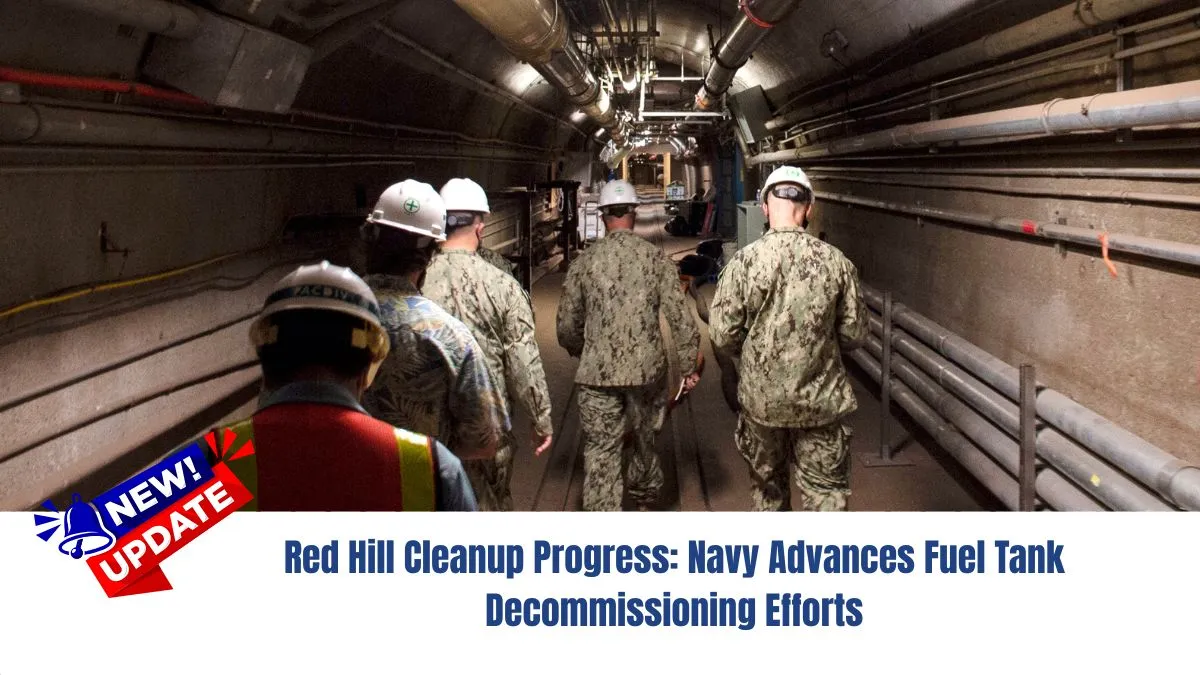
The Red Hill cleanup progress has reached an important stage as the U.S. Navy continues its work at the fuel storage facility located at Joint Base Pearl Harbor-Hickam. This development highlights steady movement toward safely shutting down aging fuel tanks while protecting nearby communities.
Major Update on Red Hill Cleanup Progress
The Navy has taken another big step forward in the Red Hill cleanup progress by starting the degassing process for Tank 12. This tank is now the 10th out of 14 tanks currently undergoing a detailed and carefully managed cleanup procedure.

Before the defueling process even began, six out of the total 20 tanks were already empty and no longer operational. The current work is part of a long-term plan to completely decommission the remaining tanks.
How the Tank Decommissioning Process Works
Decommissioning fuel tanks is not a simple task. It involves multiple stages to ensure safety and environmental protection. These steps include:
| Stage | What Happens |
|---|---|
| Defueling | Removing all remaining fuel from the tank |
| Venting | Releasing gases safely through controlled systems |
| Cleaning | Eliminating residue and contaminants |
| Closure | Permanently shutting down the tank |
Each step is carefully monitored to prevent risks to workers and nearby residents.
Degassing Process Explained

With approval from the Hawaii Department of Health (DOH), the Navy’s Closure Task Force has begun the venting phase—also known as degassing—for Tank 12.
During this stage, volatile organic compounds (VOCs) are removed by pushing clean air from the bottom of the tank. This forces harmful emissions out through a controlled ventilation system.
This step is critical in ensuring that the tank is safe before moving on to cleaning and final closure.
Air Quality Monitoring and Community Safety

To protect the surrounding community, the Navy has set up a strong air quality monitoring system as part of the Red Hill cleanup progress.
There are nine monitoring stations placed in and around the facility, including one at the Halawa Correctional Facility. These stations continuously track:
- Air quality levels
- Emission concentrations
- Wind speed and direction
- Temperature and humidity
- Barometric pressure
This data helps officials quickly respond if any unusual changes occur during the degassing process.
Strict Monitoring During Degassing
The Navy has confirmed that emissions will be closely watched throughout the ventilation phase. The goal is to ensure that all emissions stay below the limits set by the Department of Health.
Residents can stay informed by:
- Visiting the official task force website
- Using the mobile app that provides hourly updates during degassing
- Contacting the Navy Call Center at (808) 210-6968 for questions or concerns
The ongoing Red Hill cleanup progress shows that the Navy is moving steadily toward safely shutting down the fuel storage facility. With multiple tanks already processed and strict safety systems in place, the operation reflects a careful balance between environmental responsibility and operational efficiency.
Continuous monitoring, transparent updates, and coordination with health authorities ensure that nearby communities remain protected throughout every phase of the cleanup.