
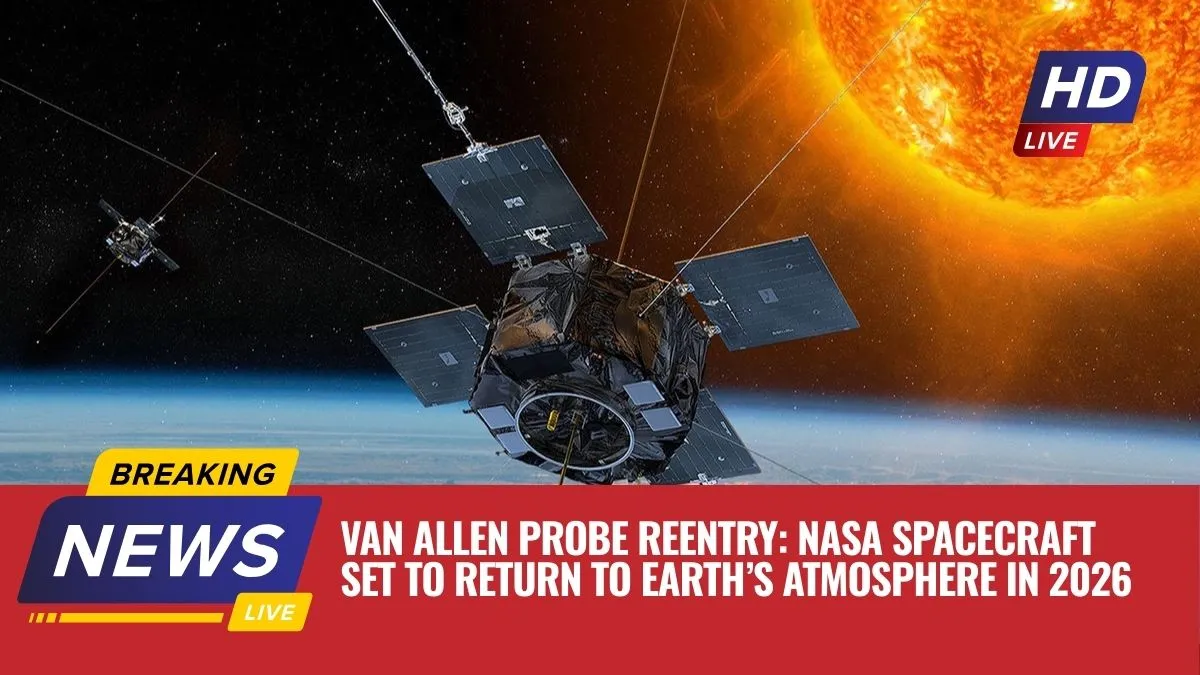
The Van Allen Probe Reentry event is drawing attention from scientists and space enthusiasts around the world. NASA has confirmed that Van Allen Probe A, a spacecraft launched in 2012 to study Earth’s radiation belts, is expected to fall back into Earth’s atmosphere in March 2026.
For nearly seven years, the spacecraft gathered valuable data about the Van Allen radiation belts, a region filled with high-energy charged particles surrounding our planet. Now, almost 14 years after launch, the mission is reaching its final stage with the Van Allen Probe Reentry predicted by the U.S. Space Force. Scientists say most of the spacecraft will burn up during re-entry, while only a few fragments may survive.

This Van Allen Probe Reentry highlights both the success of the mission and the challenges of predicting spacecraft lifetimes in Earth’s orbit.
Overview of the Van Allen Probe Reentry
According to predictions released on March 9, 2026, the U.S. Space Force estimates that Van Allen Probe A, weighing around 1,323 pounds (600 kg), will re-enter Earth’s atmosphere at approximately 7:45 p.m. EDT on March 10, 2026.
However, there is an uncertainty window of ±24 hours, meaning the Van Allen Probe Reentry could occur slightly earlier or later.
Key Reentry Details
| Detail | Information |
|---|---|
| Spacecraft | Van Allen Probe A |
| Launch Date | August 30, 2012 |
| Predicted Reentry | March 10, 2026 |
| Estimated Time | 7:45 p.m. EDT |
| Weight | Approx. 1,323 pounds |
| Reentry Window | ±24 hours |
| Risk to Humans | About 1 in 4,200 |

NASA has explained that most of the spacecraft will burn up due to intense heat and friction during atmospheric entry. Some stronger components may survive the descent, but the risk of harm to people on Earth is extremely low.
Both NASA and the U.S. Space Force will continue tracking the spacecraft as the Van Allen Probe Reentry approaches.
Mission Background: The Van Allen Probes
The Van Allen Probes mission was originally designed to last two years, but it exceeded expectations by operating for almost seven years.

Two spacecraft were launched together:
- Van Allen Probe A
- Van Allen Probe B
These spacecraft were sent to study the Van Allen radiation belts, which are zones of high-energy particles trapped by Earth’s magnetic field.
The belts play a critical role in protecting Earth from:
- Cosmic radiation
- Solar storms
- Solar wind
These radiation belts act like a natural shield, preventing dangerous space particles from reaching Earth’s surface and damaging satellites or harming astronauts.
Why the Radiation Belts Matter
Understanding the Van Allen radiation belts is important because they influence many modern technologies.
Scientists study these belts to better understand how space weather affects:
- Satellites
- GPS navigation systems
- Astronaut safety
- Communication networks
- Power grids on Earth
The Van Allen Probe Reentry marks the final stage of a mission that provided unprecedented insight into how these radiation belts form, change, and respond to solar activity.
Historic Discoveries Made by the Mission
During its operational years, the Van Allen Probes made several groundbreaking discoveries.
One of the most significant findings was the temporary third radiation belt.
Major Discoveries from the Mission
| Discovery | Explanation |
|---|---|
| Third Radiation Belt | Scientists discovered a temporary third belt forming during strong solar storms |
| Particle Behavior | Data showed how particles move and become trapped in Earth’s magnetic field |
| Space Weather Impact | Helped scientists understand how solar storms influence radiation levels |
| Satellite Protection | Provided information to help design better radiation-resistant spacecraft |
The discovery of the temporary third radiation belt surprised scientists and changed the way researchers understand Earth’s magnetosphere.
Why the Reentry Is Happening Earlier Than Expected
When the mission officially ended in 2019, scientists estimated that Van Allen Probe A would remain in orbit until 2034.
However, the spacecraft’s orbit began to decay faster than predicted.
Role of the Solar Cycle
The main reason for the earlier Van Allen Probe Reentry is the current solar cycle.
In 2024, scientists confirmed the Sun had reached solar maximum, a period when the Sun produces intense activity such as:
- Solar flares
- Coronal mass ejections
- Increased solar radiation
These events cause space weather disturbances, which expand Earth’s upper atmosphere slightly. This increase creates additional atmospheric drag, slowing down satellites and spacecraft.
Because of this stronger-than-expected drag, Van Allen Probe A is returning to Earth years earlier than originally predicted.
How the Mission Continues to Help Scientists
Even though the spacecraft stopped operating in 2019, its data remains extremely valuable.
Researchers continue to analyze the mission’s archived information to better understand:
- Space weather forecasting
- Radiation risks to astronauts
- Satellite protection strategies
- Solar activity impacts on Earth
The information collected during the mission helps scientists predict solar storm effects that could disrupt communication networks, satellites, and power infrastructure.
The Van Allen Probe Reentry may mark the physical end of the spacecraft, but its scientific contributions will continue for many years.
What About Van Allen Probe B?
The second spacecraft, Van Allen Probe B, is still orbiting Earth.
NASA predicts that Van Allen Probe B will remain in orbit longer and is not expected to re-enter Earth’s atmosphere before 2030.
This means the Van Allen Probe Reentry happening in 2026 only applies to the A spacecraft, while its twin will continue orbiting for several more years.
The upcoming Van Allen Probe Reentry represents the final chapter of one of NASA’s most important missions for studying Earth’s radiation environment. Launched in 2012, the spacecraft spent years exploring the dangerous but fascinating region of charged particles surrounding our planet.
Its discoveries — including the unexpected third radiation belt — helped scientists better understand how solar activity affects Earth, satellites, and astronauts. Although Van Allen Probe A is expected to burn up during atmospheric reentry in March 2026, the scientific knowledge gained from the mission continues to shape modern space weather research.
The Van Allen Probe Reentry also reminds us how dynamic space is and how solar activity can influence spacecraft orbits. Even after the spacecraft disappears, its data will continue guiding scientists as they explore and protect Earth’s space environment.