
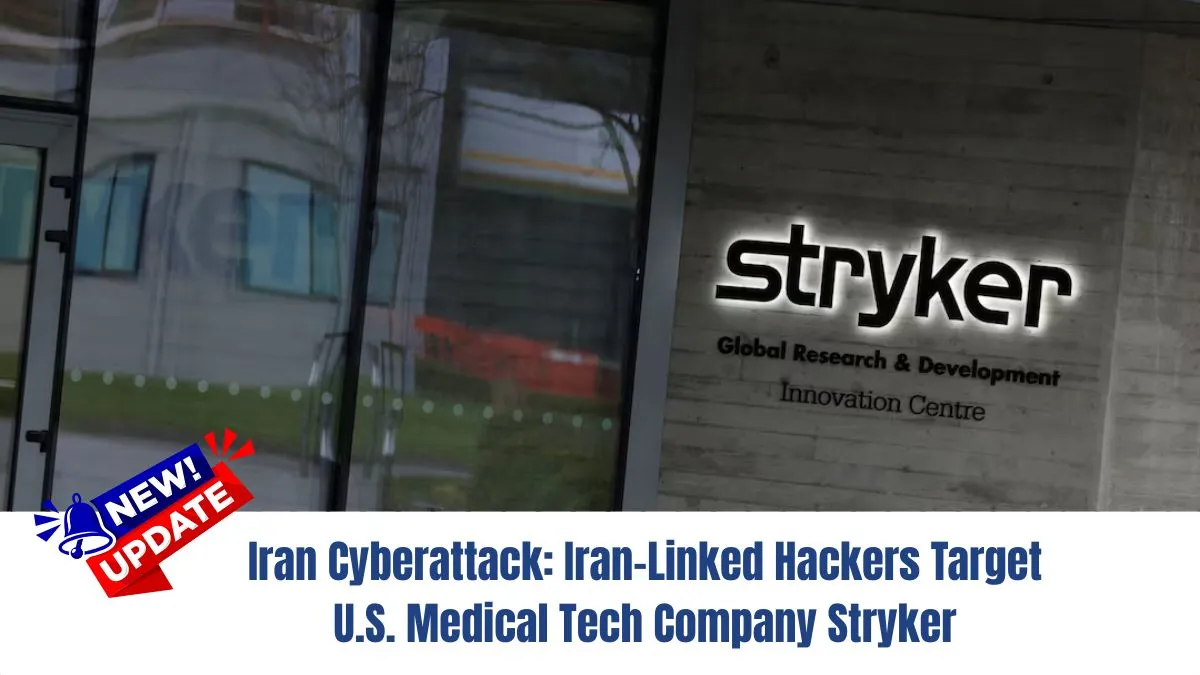
The Iran cyberattack threat has taken a new turn after an Iran-linked hacking group reportedly targeted a major American medical technology company. The incident marks what experts believe could be the first major Iran cyberattack against a U.S. company since tensions escalated into open conflict between the two countries.
The company affected is Stryker, a Michigan-based manufacturer known worldwide for producing advanced medical devices, hospital equipment, and healthcare technologies. According to cybersecurity experts and internal sources, the attack disrupted employee devices and communications across parts of the organization.

While cyber activity tied to Iranian groups has continued throughout the conflict, this incident appears more significant than previous attempts, raising fresh concerns about cyber warfare and digital infrastructure vulnerabilities.
What Happened in the Iran Cyberattack on Stryker?
On Wednesday, reports surfaced that an Iran-linked hacker group called Handala Team claimed responsibility for a cyberattack that impacted Stryker’s internal systems.
An employee at the company stated that work-issued phones suddenly stopped functioning, preventing staff from communicating with colleagues and disrupting normal operations.

Although the attack affected the company’s Microsoft environment, Stryker confirmed that its main systems were not directly compromised.
The company released a statement explaining the situation:
| Incident Detail | Information |
|---|---|
| Targeted Company | Stryker |
| Company Location | Michigan, United States |
| Industry | Medical Technology |
| Suspected Hacker Group | Handala Team |
| Type of Attack | Device wipe through management system |
| Ransomware Involved | No |
| Malware Detected | No |
| Main Impact | Employee device disruption |
Stryker said the disruption occurred due to unauthorized activity within its Microsoft environment, but emphasized that the situation had been contained and did not involve ransomware.
Who Is Behind the Iran Cyberattack?

The group claiming responsibility, Handala Team, is believed by cybersecurity analysts to have connections with Iran’s Intelligence Ministry.
The group announced the attack on its Telegram and X (formerly Twitter) accounts, where it frequently posts claims about hacking activities.
Many of its previous accounts on social media platforms have been removed, but the group often recreates them to continue publishing statements about its operations.
Cybersecurity firm Sophos has been monitoring the group’s activity and believes it operates with state-linked backing.
According to Rafe Pilling, director of threat intelligence at Sophos, the hackers likely gained access to a corporate device management platform.
How the Iran Cyberattack Was Likely Carried Out?
Experts believe the attackers accessed Microsoft Intune, a widely used enterprise system that allows companies to manage employee devices remotely.
If attackers gain access to this platform, they can control thousands of devices from a central dashboard.
In this case, hackers appear to have used Intune’s remote wipe feature, which allows administrators to erase devices for security reasons.
Possible Attack Method
- Hackers obtained access to the Microsoft Intune management console.
- They used administrative controls inside the platform.
- The attackers triggered remote device resets.
- Company phones were wiped and returned to factory settings.
Rafe Pilling explained that the wipe function is normally used when:
- A device is lost or stolen
- A company retires or repurposes equipment
- A device needs secure erasure
However, in this case, it appears the function was misused by attackers.
Iran’s History of Major Cyberattacks
The latest Iran cyberattack has drawn comparisons to earlier destructive cyber campaigns attributed to Iranian hackers.
Iran has previously used “wiper” cyberattacks, which are designed to permanently erase data across computer networks.
Two notable incidents include:
| Year | Target | Details |
|---|---|---|
| 2012 | Saudi Aramco | Massive cyberattack that wiped data from thousands of computers |
| 2014 | Sands Casino | Data destruction attack following political tensions |
These attacks are widely considered among the most destructive cyber operations linked to Iranian groups.
Cyber Activity Since the U.S.–Iran Conflict Escalated
Since tensions escalated between the United States and Iran, cybersecurity experts have been closely monitoring Iran cyberattack activity.
Until now, most incidents attributed to pro-Iran hackers involved:
- Website defacement
- Small-scale disruptions
- Online propaganda campaigns
Technology companies including Google and email security firm Proofpoint have reported that many Iranian cyber groups were primarily focused on espionage activities related to the conflict.
This latest attack against Stryker may represent a shift toward more disruptive operations.
Company Response to the Cyber Incident
Stryker confirmed the disruption publicly and stated that its core systems remained secure.
The company emphasized:
- No ransomware attack occurred
- No evidence of malware infections
- The cyber incident appears contained
The company said the issue was limited to its Microsoft environment, which affected employee devices but did not compromise broader operations.
Cybersecurity teams continue to investigate the attack to determine how the hackers gained access and whether any data was exposed.
Why the Iran Cyberattack Matters?
This Iran cyberattack highlights the growing role of cyber warfare in modern geopolitical conflicts.
Rather than traditional military actions, nations and affiliated groups increasingly rely on digital attacks to disrupt infrastructure, companies, and communications.
Key concerns raised by this incident include:
- Vulnerabilities in enterprise device management platforms
- Risks to healthcare technology companies
- The expanding role of state-linked hacking groups
As tensions between countries rise, experts warn that cyberattacks targeting corporations may become more frequent.
The alleged Iran cyberattack on Stryker represents a significant escalation in cyber activity linked to the ongoing conflict between Iran and the United States. Although the company’s core systems appear secure, the attack disrupted employee devices and highlighted vulnerabilities in enterprise management tools like Microsoft Intune.
With the Handala Team claiming responsibility and cybersecurity analysts tying the group to Iran’s intelligence apparatus, the incident underscores the increasing role of cyber operations in geopolitical conflicts. As governments and companies strengthen their defenses, this event serves as a reminder that modern warfare increasingly extends into the digital world.